|
Home Join Mag Fees Links
Imperialism in the 21st Century:
Iraq/Palestine - End the Occupation!
February 15, 2003 saw the largest ever demonstration in Britain, with
around two million taking to the streets of London as part of a worldwide
day of demonstrations against war on Iraq. As Blair hid away, worried that
he might have to leave his job, people from all sections of society – but
most importantly many workers and young people – rejected his and Bush’s
justifications for the ‘War on Terror’. It was also clear to many who
demonstrated against the war on Afghanistan and Iraq, that these wars had in
fact nothing to do with protecting ordinary people in the US and Europe from
terrorism, but were about the interests of US and UK imperialism in the
Middle East, in particular the control of oil.
A few weeks before, and on the day the war did start, there were mass
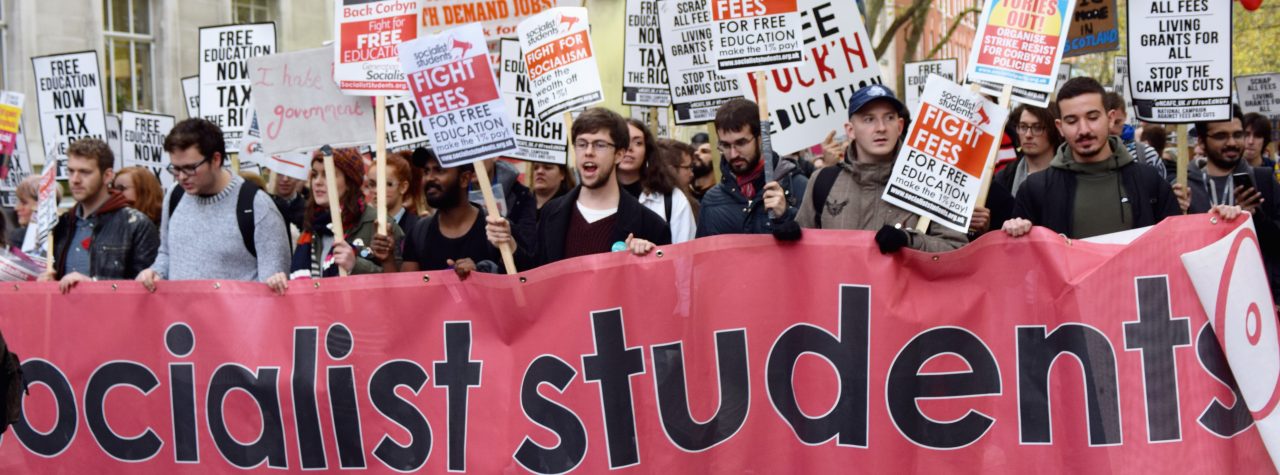
school student strikes and local demonstrations, with many Socialist Student
members playing a leading role. At the time, Socialist Students pointed out
that despite the massive scale of the anti-war movement, it would have been
extremely difficult to stop the war without mass industrial action and
credible political opposition in the form of a mass workers’ party,
although there is no doubt that the anti-war movement did shake Blair.
After the US/UK ‘victory’ in Iraq was declared, although many
ordinary Iraqis were happy to see the back of Saddam, it soon became clear
to them that the occupation has nothing to do with their rights and
everything to do with control of the economy. While nothing was done about
looting and attacks on schools, hospitals and other services, the oil
pipelines were well guarded by occupation troops. It was only the heroism
and organisation of Iraqi workers and communities, particularly in the
hospitals, that prevented an even higher rate of death and injury.
This brutal occupation is oppressive and repressive, involving
roadblocks, heavy handed treatment and the shooting of suspects. We call on
the troops to immediately pull out of Iraq and for the Iraqi people to
democratically decide their own future. But we argue that, if the struggle
against the occupation is to lead genuine national liberation, rather than
ethnic and religious conflict, or even a new ‘home-grown’ dictator, it
should be based on organisations of the working class and the poor that can
unite across religious and ethnic divides.
After the slaughter of over 1,000 civilians by US troops in Falluja,
Sunni and Shia forces came together, showing the potential for a united
movement. We support the building of united workers’ organisations in
Iraq, including democratic multi-ethnic defence forces. The movement against
the occupation should fight for an Iraqi-wide government of the working
class and urban and rural poor that could involve a democratic and socialist
programme.
The development of struggles of workers in Iraq, hardly mentioned in the
press in the west, is central to the struggle against the occupation. There
have already been strikes and protests coming from teachers, oil workers,
engineers and many other workers demanding the removal of senior members of
Saddam’s Ba’ath regime from positions of power, decent wages and rights
at work. It is through this kind of mass action that links can be made with
the labour movements in the US and UK for united action against imperialism.
The recent cases of abuse of Iraqi prisoners at Abu Ghraib prison show
the brutal reality of ‘liberation’ of Iraq. Such images, together with
increasing military casualties in Iraq and a feeling amongst the troops that
they are not welcome, have had an enormous effect on the consciousness of a
layer in US and UK societies. People who may initially have supported the
war as a means of removing Saddam can now see the reality of this war and
are increasingly moving into action against it. Ordinary Americans do not
want a drawn-out, unpopular occupation reminiscent of Vietnam, when US
imperialism was defeated by the Vietnamese resistance and opposition in the
US itself. The ‘handover’ of power last summer has not and will not
significantly change the situation. It was clear from the outset that US and
UK troops were going to stay in Iraq regardless of what the government said
– although of course the members of the government would be carefully
chosen by the occupying forces! Real national liberation for Iraq is not
possible on a capitalist basis; this will not come about with so-called fair
and free elections. National liberation from imperialism in Iraq, and the
whole region for that matter, is only achievable when the main industries,
including oil, are returned to public ownership under the democratic control
of the working class.
Socialist Students opposes imperialism in all its forms, whilst
recognising that the struggle against imperialism must be linked to the
class struggle if it is to be successful. The long-standing and brutal
Israeli occupation of Palestine has not been defeated either by the rotten
compromises of Arafat or the divisive tactics of Hamas and Jihad. Sharon is
able to push through his attacks on the living standards of Israeli workers
by keeping them scared of terrorism, a fear that enables him to continue
political murders, house demolitions and the construction of the
expansionist wall in the West Bank. A mass movement of Palestinian workers
and youth against imperialism and capitalism could link up with a similar
movement in Israel and would undercut support for Sharon and form the basis
for a lasting peace with a socialist Palestine next to a socialist Israel,
working as part of a broader socialist confederation of the Middle East.
Thomas House – Sussex Socialist Students
Advertise Peter Taaffe’s book on Vietnam……
|